
 Solicitar Orçamento
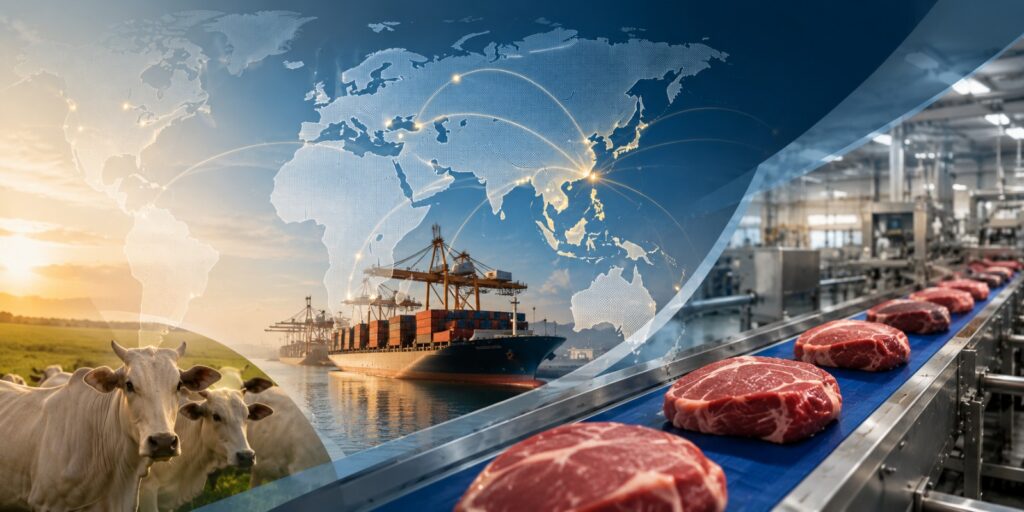
 Brazil continues to strengthen its position in the global animal protein market. Among the destinations gaining relevance is Asia, where changing consumption patterns and rising purchasing power are creating new opportunities for Brazilian meat.
The Philippines is a clear example of this movement. According to projections from the Brazilian Beef Industry and Exporters Association (Abiec), Brazil could ship between 80,000 and 96,000 tons of beef to the country in 2026. During the first half of the year, shipments reached 35,900 tons, 34.6% above the same period in 2025.
Beyond the export figures themselves, this scenario highlights a broader transformation: Brazil’s protein industry is becoming increasingly integrated into a global supply chain in which competitiveness depends on production capacity, quality and the ability to meet the requirements of different markets.
Asia gains importance in Brazil’s export strategy
The expansion in the Philippines is part of a broader diversification of destinations for Brazilian animal protein.
Economic development, rising income and growing beef consumption among younger consumers are helping sustain demand in the Asian market. The opening of the Philippine market to Brazilian chilled beef also creates additional opportunities for exporters and meat processors.
This diversification is strategically important. A broader geographic customer base reduces dependence on individual markets and gives Brazilian companies greater flexibility in responding to changes in international trade.
Recent initiatives by Abiec and ApexBrasil in Southeast Asia reinforce that this is not an isolated movement, but part of a broader strategy to expand the global presence of Brazilian beef.
New markets require a more capable industry
Winning international customers is only part of the challenge.
To serve different markets, processors must combine scale, standardization, food safety, productivity and operational flexibility. These capabilities are directly connected to the technology used throughout processing facilities.
Companies preparing for expansion need to eliminate bottlenecks, improve process efficiency and maintain consistent standards as production volumes increase.
This is where equipment modernization becomes more than an operational decision. It becomes part of the company’s competitive strategy.
Efficiency also means adding value
The evolution of the protein market is not limited to increasing the volume of meat traded internationally.
Consumers around the world are increasingly looking for convenience. This supports categories such as shredded meat, cubes, strips, burgers, fillings and other processed protein products.
For meat processors and food manufacturers, transforming raw material into higher-value products can create an additional growth opportunity.
However, this strategy requires precise and repeatable industrial processes capable of maintaining productivity and consistency at scale.
Processing equipment therefore plays an increasingly important role in building this efficiency.
Technology as a competitive advantage
Brazil’s export expansion demonstrates that international demand for its animal protein remains strong. The next challenge is ensuring that companies have the infrastructure required to capitalize on this growth.
Automation, high-productivity equipment and standardized processes can help reduce waste, improve raw-material utilization and increase production capacity.
Ultimately, competitiveness is not simply about reaching new countries. It is about serving those markets consistently.
Precisão Inox: technology for protein processing
This is where technology becomes a key component of modern food processing.
Precisão Inox develops AISI 304 stainless steel equipment for different stages of animal protein processing, with solutions focused on productivity, standardization and industrial efficiency.
As Brazil expands its presence in international markets, investing in more efficient processes is no longer simply an option—it is a strategic decision.
New markets are emerging. The companies prepared to produce efficiently will be better positioned to turn international expansion into sustainable growth.
Reference source: CNN Brasil, “Brazil could export up to 96,000 tons of meat to the Philippines in 2026,” published on August 12, 2026. Additional information: Abiec and ApexBrasil. CNN Brasil — reference article